

Storyteller: Old Crockern - a timely reminder
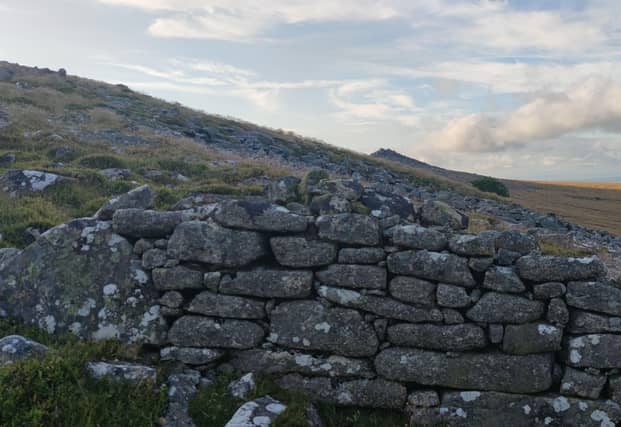

Many of you will be aware that recently a law was passed banning what is known as wild camping on Dartmoor without the landowner’s permission. This is a recreational pursuit, whereby you carry your tent, and all the necessary provisions for a night’s sta
Many of you will be aware that recently a law was passed banning what is known as wild camping on Dartmoor without the landowner’s permission.
This is a recreational pursuit, whereby you carry your tent, and all the necessary provisions for a night’s stay under the stars, in a rucksack, and leave no trace that you were there the following morning.
It has been taken for granted by many people, for many years, that this practice was permitted, as long as it was done respectfully, even forming the basis of the Ten Tors Challenge and the Duke of Edinburgh’s Award where young people have to spend a night under canvas while completing a set course.
This is often a person’s first chance to commune with nature and to learn how to respect it.
Having this opportunity taken away risks producing generations who don’t know how to treat the open spaces around them, encouraging them to cause the very offences that the bringers of this case to court are trying to prevent.
I wouldn’t normally use my column to highlight issues that have reached national news status but as Dartmoor is something I’m really passionate about, I feel the need to bring it up here, especially as the protestors and activists, against the judge’s verdict, have introduced a touch of folklore into the proceedings.
Those that are trying to protect our right to roam freely over the moor, and to be able to pitch a tent at the end of a long day’s walk, to then spend the night there too, have recently organised a series of protests and walks over the land belonging to the bringer of the court case, in which they want to invoke the traditional guardian spirit of Dartmoor, Old Crockern, to help them in their cause.
Old Crockern traditionally lives under Crockern Tor, from where he takes his name, which is said to be positioned at the centre of the moor, as determined by the tinners when choosing to hold their stannary parliament there, so everyone had to travel the same distance, from the outlying stannary towns, to get there.
Some say he is the spirit of an old miner that got left behind when the industry closed down many years ago. His description varies, from a skeletal rider roaming the moor on dark nights astride a skeletal horse, to being as 'grey as granite, his eyebrows hanging down over his glimmering eyes like sedge, his eyes as deep as peat water pools'.
Throughout the years, his one aim has been to protect Dartmoor from money-hungry land grabbers eager to make their fortunes off the back of the land. His mantra is: “If he scratches my back, I'll tear out his pockets!”
If this is the case, it seems odd that this character is associated with the tinners of old, for they certainly strived to become rich off the land, and were quite ruthless about it.
That was until they chose to imprison a member of parliament from Plymouth in their jail at Lydford Castle. His rich friends came to rescue him, breaking the domination of the miners, and causing their industry to go into decline shortly afterwards.
History has given us several examples of how Old Crockern can bring down greedy landowners.
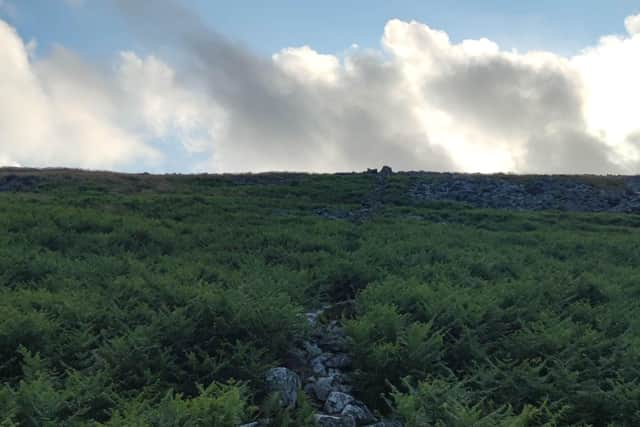
To the north of Dartmoor, straddling the ridge at Belstone, can be found the remains of what has become known as Irishman’s Wall. This was an attempt by a group of Irish men to tame the moor by enclosing part of it with a very long stone wall, thus enforcing their ownership.
This act of desecration to their beloved homeland incensed many locals to take action. During the night, a large group of them paid a visit to the wall and pushed it down, illustrating their displeasure. The men from Ireland got the message, packed their bags and returned home.
The ruined wall remains as a warning to any other landowners who might overstep the mark.
Personally, I’ve never spent a night under canvas on Dartmoor during all the years I’ve walked on it, although I’m not averse to the idea.
I did once spend a Midsummer’s Eve under a canopy of trees in a certain well-known wood. No tents were involved, nor fires lit, it was just a group of friends sitting respectfully on the rocks waiting for the sun to come up. No twigs cracked, or leaves rustled, the wood was perfectly silent.
It was a truly magical night, one of the most memorable of my life, thus far. There is no way I would attempt to prevent future generations from having similar experiences.