

Storyteller: Murder mystery in South Devon church
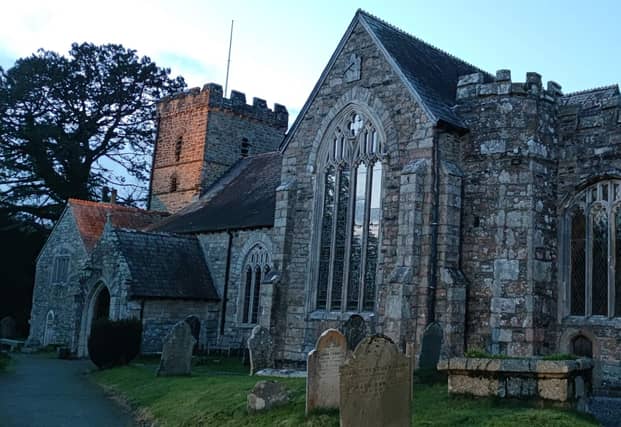

The other Sunday, my walking group met in South Brent to go on a walk up the River Avon, led by my good friend Kathy. We followed the footpath to Lydia Bridge in Aish, and then took a route through woodland and along lanes, until we reached the new refre
The other Sunday, my walking group met in South Brent to go on a walk up the River Avon, led by my good friend Kathy.
We followed the footpath to Lydia Bridge in Aish, and then took a route through woodland and along lanes, until we reached the new refreshments van at Shipley Bridge.
We made use of the facilities, before heading back on the other side of the river, via footpaths and lanes, through Didworthy, back into South Brent.
Finding ourselves with time to spare before the meal we had booked, I suggested we take a look around St Petroc’s, the local parish church.
Those of you who read my column regularly will know I’ve recently developed a keen interest in an intriguing feature present on certain older churches, known as the Devil’s Door, and that is exactly what I went looking for here in South Brent.
These doors have been purposely blocked up to prevent their use by, not only the Devil, but also by non-conforming Pagans, and even Catholics, during their celebration of special holy days throughout the church year.
They are usually found on the north wall, for this is the direction from which Pagans traditionally enter their stone circles, in order to perform their rituals and ceremonies, and by sealing them up, the church demonstrated they were no longer welcome, along with the Devil, whom they were said to be in league with.
Once we entered the churchyard, it wasn’t long before I spotted a blocked-up window, as well as, what I initially thought was a fine example of a Devil’s Door.

As I searched around for a guide to the history of the church, the key holder arrived to lock up for the night, so I took the opportunity to ask if he knew anything about the Devil’s Door. He looked puzzled, so I pointed out the blocked-up door, which he said was known as the 'Murder Door'.
Apparently, in the 1400s, the incumbent vicar was set upon, dragged outside, through the doorway to the left of the altar, and murdered, but no one knows why.
Returning home after our meal, and still intrigued by the thought of a 'Murder Door', I resorted to consulting my own library, and searching online.
It didn’t take long to find a guide to St Petroc’s Church, compiled by Peter Taylor, which is very in-depth, for not only does he talk about the murdered vicar, he also sheds light on the Devil’s Door custom.
During baptisms, it was traditional for the north door to be opened in order for the Devil to exit the church, after being exorcised during the ritual. It was then kept firmly closed until the next baptism service.
I have heard tales referring to this practice still being carried out in more enlightened times, showing that you can’t keep a good superstition down, even if the earlier Devil’s Doors have been sealed up.
The online guide suggests that St Petroc’s wasn’t exempt, having its north entrance sealed up in the 1800s, only to be opened again in 1999.
But what of the 'Murder Door'? In John Van Der Kiste’s book, A Grim Almanac of Devon, there is an entry for June 1436, stating that on the Feast of Corpus Christi, the Reverend John Hay, who had been in position for eight years, was in the middle of officiating at evening service, when a group of men, led by Thomas Wake, burst into the church, attacking the vicar, dragging him outside, via the small door by the altar, where they beat and stabbed him to death.
Thomas Wake was apprehended and executed for his crime, taking the secret of his brutal attack to his grave.
At the time, this was regarded as one of the most notorious murders in Devon, ranking up there with the killing of Thomas Becket in Canterbury Cathedral. So much so, that Bishop Lacey of Exeter felt compelled to re-consecrate the church and churchyard, and it was probably then that the decision was made to seal up the door, as a mark of respect to Reverend Hay, meaning it will be forever known as South Brent’s 'Murder Door'.