

Storyteller: Exploring Dartmoor in the summertime

David Phillips, Tales from the Storyteller: You would have thought that the summer would be the ideal time for walking on Dartmoor, longer daylight hours and a bit of sun, but sadly, no, not in the sort of heat we are experiencing at the moment! When yo
David Phillips, Tales from the Storyteller:
You would have thought that the summer would be the ideal time for walking on Dartmoor, longer daylight hours and a bit of sun, but sadly, no, not in the sort of heat we are experiencing at the moment!
When your hobby is letterboxing, which involves a lot of walking around in the same area, ploughing through dense bracken and long grass, trying to locate the right rock with a box under it, it soon saps your energy.
This time of year, I can only usually manage a few hours, even leaving it until later in the day, once it’s supposedly a bit cooler, before having to pack it in.
That’s exactly what I did last week. Having been reminded that the army ranges aren’t in use during the school holidays, I decided to pay a visit to the Wilsworthy Firing Range, the one that is used the most, as it is a shooting range rather than a training exercise area.
I got there late afternoon, and started looking for boxes hidden inside the range, that you can only access when there is no firing.
Sadly, I only managed to find one, but it gave me the opportunity to explore more.
I’ve walked this particular range several times before, and the thing that fascinates me the most are the army observation posts.
There are similar bunkers and huts scattered all over the northern part of the moor, where the army operates, so they can keep an eye on any rogue walkers or animals that might stray on to the ranges while they are firing.
If regular readers recall, I wrote one of my Christmas ghost stories about a young lad who had a strong desire to spend a night in an army hut… I guess I based it on my own desires!
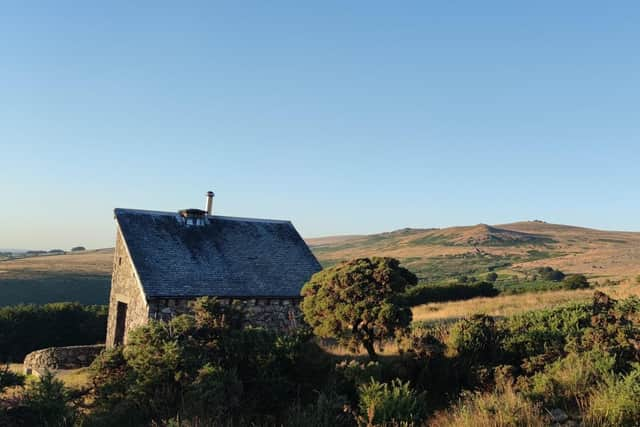
However, there is something different about the huts on the Wilsworthy Range, they look more like little chalets, suggesting they might be more comfortable to spend the night in.
There is an obvious higher one, and a slightly lower one that I discovered on my recent visit. Both have an amazing view over the surrounding landscape, and would be fantastic places to do a sky watch from at night.
The problem is, when I first got close to the higher hut, I disturbed what looked like a large rat, which ran inside the building through a vent, so you might well not be alone in there at night!
The most interesting thing I discovered during this recent exploration was the fact that one of the final sections of the Lych Way, or the Way of the Dead, wends its way across the range.
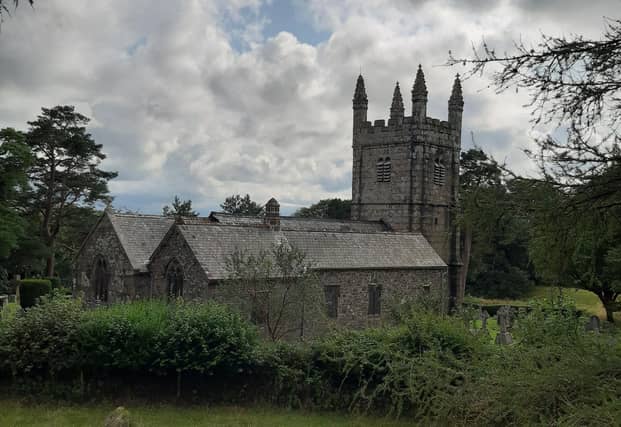
You can actually see Lydford Castle, which stands next to the church, the final destination for the bodies bound for burial there, from the slopes of White Hill, where one of the range’s flagpoles stands, for flying the red flag when firing is taking place.
The Lych Way was a track designed to offer safe passage for the bodies of the recently deceased, on their way for burial in Lydford Church, across the more remote parts of the north moor.
Until 1260, it was the law of the land that all burials had to be conducted in the parish church, no matter how close the deceased had lived to it.
Unfortunately for the residents of Dartmoor, they happened to live in the largest parish in England, Lydford, and the village, with its parish church, happened to lie to the west of a most barren stretch of wilderness.
Anyone who died on the south of the moor, had to be transported, either by teams of coffin bearers, or on the backs of pack animals, to their final resting place.
Getting to the central Postbridge area was fairly easy, from there they took to the Lych Way to cross the open moor.
If you were unfortunate to die during a harsh winter, you would have to wait under any snow had thawed, before any attempt could be made to take you on your final journey.
In 1260, the people of Dartmoor demanded a change to the law, as conditions for transportation of the dead seemed so unfair for the population of such a vast, barren parish.
The then Bishop of Exeter happened to agree with them, and decreed that henceforth burials would be allowed at Widecombe in the Moor, the largest church in the south of the moor, and, thereafter, all other local churches.
So, the Lych Way was no longer needed to transport the dead, but it was still used by those who needed to cross that part of the moor who had business in the village, especially the court sessions that were held in Lydford Castle.
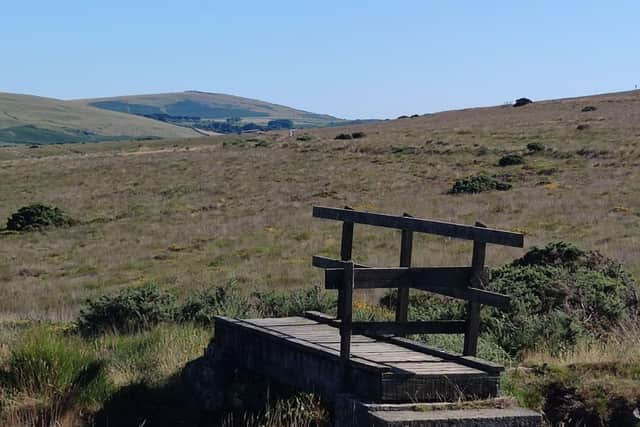
To this day the route is still well trod, by the many who visit the moors following the clearly signposted track, as I found out when I came across a bridge spanning the Mine Leat, on the edge of the range, complete with Lych Way sign…
Well, with parts of it aptly named Corpse Lane and Coffin Wood, is it surprising that, over the years, there have been sightings of a column of monks, accompanying a funeral cortege, processing along part of it?
At night, in Coffin Wood, sometimes the flaming torches of a team of pall bearers can be seen, as they await the arrival of a coffin to be transferred to them, to do their bit to help the dearly departed on their way.
I’ve been in this area several times in the dark, as yet I haven’t seen anything, but I always live in hope.