

Stargazing with Torbay Astronomical Society: Pushing back the final frontier!
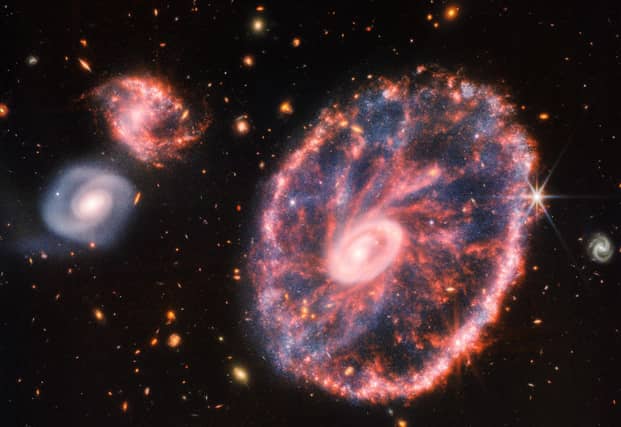

Stargazing with Torbay Astronomical Society: By now you will probably have seen the first images returned from the James Webb Space Telescope. One of these images contains thousands of galaxies. To put this image in perspective, it covers an area of sky
Stargazing with Torbay Astronomical Society:
By now you will probably have seen the first images returned from the James Webb Space Telescope.
One of these images contains thousands of galaxies. To put this image in perspective, it covers an area of sky the size of a single grain of sand held up at arm’s length.
It also, intentionally, overlaps an area already imaged by the Hubble Space Telescope. This is to test the greater resolution of the JWST.
The JWST is also designed to take images in the infra-red part of the spectrum. This allows it to detect cooler, fainter, and more distant images than Hubble could.
In the image, known as the JWST First Deep Field, everything that appears white was imaged by Hubble but most of the reddish-coloured objects in the image were invisible to Hubble and have been imaged for the first time by Webb.
These objects are older and therefore cooler and more distant than any objects seen before.
The JWST also has the advantage of improved imaging technology. Both the Webb and the Hubble images are composites of multiple frames at multiple wavelengths.
The Hubble image took several weeks to build up the information whereas the Webb image was composed in 12-and-a-half hours!
The image shows galaxies as they appeared 4.6 billion years ago and contains enough data to keep researchers busy for years.
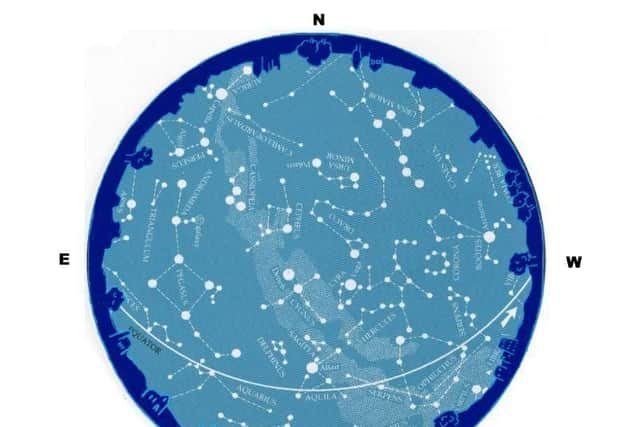
The Star Chart
The sky will look like the chart on August 23 at 8pm. And four minutes earlier on each successive night.
To use the chart hold it above your head while facing south so that you can look directly from the chart to the sky.
Skynotes
Please note all times given in this article are in GMT so remember to add an hour to get the time in BST.
Sun: Astronomical darkness increases to six hours by the end of the month, so fainter objects are again becoming observable.
Mercury and Venus: Both of these inner planets are closer to the Sun than the Earth so are never very far from the Sun, especially Mercury.
Mercury set about 40 minutes after the Sun on August 1 and was seen against the background stars of Leo almost due west.
On August 27, Mercury is further from the Sun but sets just 30 minutes after it. Venus is a morning object throughout the month and can be seen against the background stars of Gemini at the beginning of the month rising two hours before the Sun.
Venus is easily the brightest object in the sky, apart from the Moon, at this time. A thin crescent Moon lies close to Venus on August 25.
By the end of the month the planet rises just 90 minutes before sunrise and has moved into the constellation of Leo.
Mars: The red planet rises by 3am and reaches a greater altitude, seen against the background stars of Taurus. On August 18, Mars lies just below the Pleiades star cluster and on August 19 it lies close to the Last Quarter Moon. Mars is getting brighter, and its apparent size is increasing as it gets closer to the Earth and its coming opposition.
Jupiter: The largest planet rose in the east about seven hours before the Sun on August 1 and another two hours earlier by the end of the month. By the middle of the month, Jupiter will lie due south and be seen against a dark sky at a greater altitude above the horizon. The coloured bands and zones on the surface of the planet can be distinguished with small telescopes as can the Great Red Spot, a colossal hurricane, greater in diameter than the planet Earth. The Galilean moons can be seen with a good pair of binoculars or a small (bird-spotting) telescope. By the end of the month Jupiter lies on the border between two constellations: Cetus (the Whale) and Pisces.
Saturn: The ringed planet could be found against the stars of Capricornus, rising in the east around 8.30pm on August 1 and another two hours earlier by August 31 when it will be visible against a dark sky and at a higher elevation. Saturn reaches opposition on August 14 when it will lie due south. The rings get brighter leading up to opposition and fade slightly afterward. This is due to our perspective view of where the shadow of the planet falls onto the rings, thus dimming them from our point of view. Saturn’s largest moon, Titan, can usually be seen with a good pair of binoculars or a small telescope.
Uranus and Neptune: Uranus is visible all night long throughout August and is seen against the background stars of Aries. At magnitude 5.8, it is visible in binoculars. Neptune is seen against the background stars of Pisces and moves into Aquarius by August 18 (below the asterism known as the Square of Pegasus). At magnitude 7.8, it will require large binoculars or a small telescope to find it. Neptune displays a smaller and truly blue disc compared to that of Uranus. Both planets are best seen at the end of the month when they can be seen against dark skies. Neptune comes to Opposition next month.
Meteor Shower: The Perseid meteor shower peaked on August 12-13. This is the best shower of the year with up to 60 meteors an hour including some very bright ones. This shower is often the brightest and most spectacular, of the annual meteor showers but a Full Moon means that some of the fainter meteors will not be visible. The Perseids are so called because they appear to radiate from a point in the constellation of Perseus. The maximum of activity took place on the night of August 12/13 when up to 60 meteors an hour was seen. Observing meteors could not be simpler. The only necessary bit of equipment is a garden recliner or deck chair so that you can lay back and look at the sky about 40 degrees above the horizon comfortably. If you want to make a record, simply count the number of meteors you see. You can also note the direction of travel, the duration, which will typically be seconds, and anything unusual such as colour, faint trails, or sound. This shower is known for producing occasional, bright fireballs.
Comet: There are no bright comets expected this month.
The First Quarter Moon occurred on August 5 with Full Moon on August 12. Last Quarter follows on August 19 with New Moon on August 26.
Diary dates
The next meeting of the Torbay Astronomical Society, complying with the current Covid regulations, will be at the Torquay Boy’s Grammar School on September 8 when Dr Mark Kidger FRAS will give a talk entitled The Outer Darkness.
Dr Kidger works as a mission scientist for the European Space Agency and has been a specialist on the Herschel Space Telescope and the New Horizons mission to Pluto and beyond.
Then, on September 22, we will begin our programme of observational meetings once again when we hope to view both, Jupiter, and Saturn.
For details contact the TAS secretary on [email protected] . Visitors and prospective members especially welcome.