

Stargazing with Torbay Astronomical Society: A sky full of planets

October sees the clocks go back an hour to GMT or Universal Time at the end of the month. Unlike many people who do not look forward to this time of year of darker, longer nights, for astronomers this is a good thing; there are more hours of darkness, an
October sees the clocks go back an hour to GMT or Universal Time at the end of the month.
Unlike many people who do not look forward to this time of year of darker, longer nights, for astronomers this is a good thing; there are more hours of darkness, and they begin earlier in the evening so that general observations can be made within a more comfortable timeframe.
Of course, we still have to wait for specific events if they are to be seen.
The darker autumn sky therefore gives us the chance to pick out the summer sky constellations and objects against a darker background.
The increase in contrast that this provides means that objects can be seen more clearly and for longer. The autumn constellations can also be seen at their best.
This year, after midnight, no less than five planets can be seen against a dark sky at the same time: Uranus, Mars, Saturn, Jupiter, and Neptune are strung out across the sky from horizon to horizon.
Of course, some of these are brighter and more obvious than others but I hope that the sky notes will help you to locate the others.
The James Webb Space Telescope has taken its first spectroscopic images of an exoplanet - a planet orbiting another star other than our Sun.
This experiment is to enable astronomers to examine the contents of the atmospheres of exoplanets and to look for markers of life within the atmosphere.
The observation in question has found the presence of carbon dioxide in the atmosphere of a planet catalogued as WASP-39, which orbits a star some 700 light years distant from our Sun.
While carbon dioxide is associated with plant life on Earth, there are many other causes that would explain its presence in the atmosphere: geological and chemical reactions can also produce the gas in copious amounts.
WASP-39 is a low-mass gas-giant planet 1.3 times the size of Jupiter and, because it orbits very close to its parent star, has an average surface temperature of 900 degrees Celsius.
This observation has been a good test for JWST’s capability to examine the atmospheres of smaller, rocky, Earth-type planets in future observations.
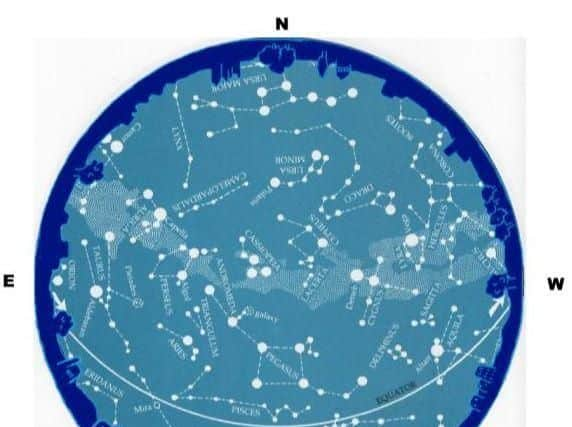
The Star Chart
The sky will look like the chart on October 23 at 8pm. And four minutes earlier on each successive night.
Skynotes
Please note all times given in this article are in GMT so remember to add an hour to get the time in BST.
Sun: From the beginning to the end of the month the period of dark sky increases from 8.5 hours to over 10 hours. The longer nights allow us to view the summer constellations and the Milky Way that runs through them against a dark sky while also introducing the autumn constellations and the interesting objects in them. There is a partial eclipse of the Sun visible from Torbay on October 25. The eclipse can be seen from 9.12am to 10.40am. Do not look directly at the Sun without suitable protection.
Mercury: Mercury is visible in the morning sky this month seen against the background stars of Virgo. The planet rises about an hour before sunrise on 1st but only 30 minutes before the Sun by October 31. Mercury reaches its greatest distance from the Sun by mid-month. To observe Mercury safely, stand with a wall or other obstruction obscuring your view of the Sun and scan the sky away and to the right of the Sun.
Venus: Venus also rises just 30 minutes before the Sun and is low in the sky in the constellation of Virgo. Venus is gradually getting closer to the Sun from our point of view and will not be easily visible.
Mars: Mars is visible against the background stars of Taurus throughout this month. The apparent size and brightness of the red planet is increasing as it approaches opposition in December. Mars can be found near the Moon on 15.
Jupiter: The largest planet rose in the south east around 5.45am on October 1 and another three hours earlier (due to the clocks changing) by the end of the month and is seen against the background stars of Pisces. The planets elevation above the horizon increases from 20 degrees the span between your thumb and little finger at arm’s length - to 40 degrees over the course of the month, making the planet ideally placed for observation. The coloured bands and zones on the surface of the planet can be distinguished with small telescopes as can the Great Red Spot, a colossal hurricane, greater in diameter than the planet Earth. The Galilean moons can be seen with a good pair of binoculars or a small (bird-spotting) telescope. DSLR images of the planet will also pick up the moons. These moons orbit Jupiter such that we sometimes see them pass between the Earth and the giant planet along our line of sight. Watch out for small black dots seen against the surface of Jupiter itself. The moon Io will cast its shadow onto Jupiter, around 8.45pm, on October 18 and on October 26, the shadows of both, Europa and Ganymede begin to transit at 20:30pm.
Saturn: The ringed planet could be found against the stars of Capricornus, rising in the east around 4.20pm on October 1 and another three hours earlier by October 31, which means it is already in the sky when darkness falls. Saturn reaches 23 degrees altitude, a little more than the span between your thumb and little finger at arm’s length, this month. The rings are beginning to open out, from our point of view and are consequently becoming brighter. Saturn’s largest moon, Titan, can be seen above and to the right of the planet with a good pair of binoculars or a small telescope.
Uranus and Neptune: Uranus is visible all night long throughout October and is seen against the background stars of Aries and close to the Pleiades star cluster. At magnitude 5.8 it is visible in binoculars. Look for a tiny greenish disc compared to the pinpoints which are the stars. Neptune is seen against the background stars of Aquarius - below the asterism known as the Square of Pegasus - and fairly close to Jupiter. At magnitude 7.8, it will require large binoculars or a small telescope to find it. Neptune displays a smaller and truly blue disc compared to that of Uranus although it will appear only as a bluish star to most small instruments. The James Webb Space Telescope has recently taken an infra-red image of Neptune which shows the planet’s faint ring system more clearly than any previous image.
Meteor shower: The Orionid meteor shower can be seen this month, occurring between October 15 and 29 with a peak on October 21. These are relatively fast-moving meteors although still only up to ten an hour. The Moon is nearing new so this is a better opportunity to see these meteors than last year. The Orionids are interesting because they are formed from the debris left behind in the wake of Comet Halley.
Comet: There are no bright comets expected this month.
The First Quarter Moon occured on October 3 with Full Moon on October 8, Last Quarter then follows on October 17 and New Moon on October 25.
Data supplied by Simon Harding, Observations Secretary Torbay Astronomical Society
Diary Dates
The next meetings of the Torbay Astronomical Society will be held at Torquay Boys' Grammar School. On October 21, an observational evening will be held when members will be delighted to provide views of the objects discussed in this article. In the event of bad weather, short talks and videos will be presented alongside informal discussion and an opportunity to get to know the society. For details, contact the secretary TAS on [email protected] Visitors and prospective members especially welcome.