

Stargazing: May is upon us and by mid-month the sky never gets truly dark

Stargazing with John Stapleton, of Torbay Astronomical Society May is upon us and by mid-month the sky never gets truly dark. In spite of this, the spring constellations are at their best and it is a good time to observe them. However, observing these
Stargazing with John Stapleton, of Torbay Astronomical Society
May is upon us and by mid-month the sky never gets truly dark.
In spite of this, the spring constellations are at their best and it is a good time to observe them.
However, observing these patterns is best done after 10pm.
Because of the way that the planets orbit the Sun, all at different speeds and at varying distances, it is possible for all of the planets to be on the opposite side of the Sun from the Earth or in the same part of the sky as the Sun and therefore not visible to us, as is pretty much the case this month with only Venus on view in the evening sky.
The founder of Torbay Astronomical Society, Mr J Hedley Robinson, who lived at Teignmouth, was the director of the Mercury and Venus section of the British Astronomical Association, a role which he took over from Patrick Moore.
I was privileged to be invited to travel with him and his son to a meeting in London where Hedley, as everyone knew him, was awarded the Walter Goodacre Medal, the highest award the association can bestow.
This was presented to him in recognition of almost 15 years of service as director and in honour of the pioneering work that Hedley, along with a small group of observers, did in the use of coloured filters when observing the planets, particularly those with atmospheres and especially Venus.
Although there was some opposition to the validity and usefulness of such observations at the time, the use of coloured filters seemed to enhance faint details visible in the atmosphere of Venus.
This was believed to be due to different wavelengths of light penetrating different layers of the planet’s atmosphere. So much so that the size and shape of the observed phase of Venus seemed to be different under different filters and this became known as the 'phase anomaly'.
Arguments about these observations were quite vehement and the problem was referred to, in BAA Journals and proceedings as the 'Filter War'.
The Star Chart
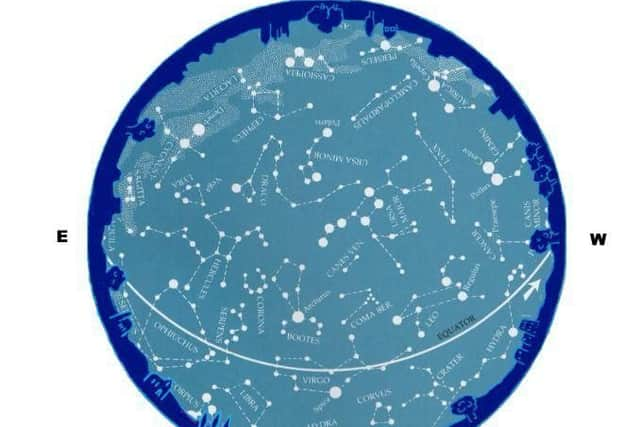
The sky look like the chart on Friday, May 5, at 9pm and again on May 21 at 8pm. And four minutes earlier on each successive night e.g. 8.56 on May 6.
To use the chart, hold it above your head while facing south so that you can look directly from the chart to the sky.
Skynotes
Please note all times given in this article are in GMT so remember to add an hour to get the time in BST.
Mercury and Venus: Both of these inner planets are closer to the Sun than the Earth so are never very far from the Sun, especially Mercury. Mercury is approaching inferior conjunction - between the Earth and the Sun so is not visible this month. Venus reaches greatest Eastern Elongation, farthest distance East of the Sun, near the end of the month and so sets about four hours after the Sun. It will be a brilliant object in the darker sky, but it would be an interesting exercise to see how soon you could spot it, above the constellation of Gemini, in the evening twilight. Venus can be visible in broad daylight because it is so bright, but you have to know where to look. Remember that you will be looking during daylight so never look directly at the Sun with an optical instrument!
Mars: The red planet is an early evening object, but it is receding from the Earth and appears both smaller and fainter than it did earlier in the year.
Jupiter: Jupiter is also in conjunction with the Sun and so is not visible this month.
Saturn: Saturn is yet another planet in conjunction with the Sun and so is not visible this month. Because the giant planets lie further from the Sun than the Earth, these conjunctions occur when our line of sight to the planet passes too close to the Sun and the planet passes behind the Sun from our point of view.
Uranus and Neptune: These planets are also not visible this month.
Meteor shower: The Eta Aquarid meteor shower, so called because the point they appear to radiate from lies near the star Eta Aquarii, peaked on May 6. Although this is expected to be a moderate shower this year, the radiant - point the meteors radiate from - lies below our horizon so we only have a limited view. Besides which, the full Moon was on Friday, May 5, so many meteors will be drowned out by the light from the Moon. Meteors from this shower are associated with Comet Halley.
Comet: There are no predicted comets visible this month.
The Full Moon occurred on May 5 with Last Quarter on May 12. New Moon occurs on May 19 with First Quarter on May 27.
Sadly, my good friend and colleague, Simon Harding, observations secretary for Torbay Astronomical Society for many years, passed away suddenly last month, so his name will no longer be appended to this article. Simon was a keen observer and asto-imager of the night sky and of the aurora borealis, the Northern Lights, which he used to travel to Norway to better observer annually. Simon also took part in many citizen science projects and was credited with the joint discovery of an exoplanet. He will be sorely missed.
Diary Dates
The next meetings of Torbay Astronomical Society will be held at Torquay Boys' Grammar School today (Thursday, May 11). This will be the society's annual meeting and members will be previewing the speakers lined up for the new season beginning in September.
Visitors and prospective members especially welcome. For details, contact the secretary of TAS on [email protected]