

Stargazer: Catalogue by King Louis XV's 'Ferret of Comets' still in use today


Stargazing with John Stapleton of Torbay Astronomical Society: In these articles I have referred to interesting objects by their “M” numbers in the Messier Catalogue; for instance, the Great Nebula in Orion is M42 and the Pleiades star cluster is M45. C
Stargazing with John Stapleton of Torbay Astronomical Society:
In these articles I have referred to interesting objects by their “M” numbers in the Messier Catalogue; for instance, the Great Nebula in Orion is M42 and the Pleiades star cluster is M45.
Charles Messier was a French astronomer living during the late 18th to the early 19th centuries. He was inspired by the discovery of a comet by another French astronomer who had the object named after him, so Messier became a comet 'hunter'.
Using his telescope, which was of poor quality by today’s standards, he methodically searched the skies in the hopes of finding signs of these notoriously faint, fuzzy, and transient objects - after all, comets were only visible as they passed close to the Earth on their passage through the solar system.
Messier began to become increasingly frustrated after noticing that there were, in fact, many faint and fuzzy objects which were fixed, that is they did not move but were always visible in the same position, which he and other observers continually mistook as comets.

This Messier Catalogue of Nebulae and Star Clusters is what the Frenchman has become famous for despite the fact that between 1760 and 1801 he discovered or co-discovered 14 comets!
In fact, he had become so expert in these observations that King Louis XV of France nicknamed him 'my ferret of comets'.
For his work, Charles Messier was made a Fellow of the Royal Society in London, a foreign member of the Royal Swedish Academy of Sciences and a member of the French Académie.
Because the catalogue contains the brightest objects of their kind, amateur astronomers, even today, use Messier’s Catalogue as a source of interesting objects to view, especially in the spring.
An annual challenge to observers is known as the Messier Marathon. At the end of March/beginning of April, if the phase of the Moon is New or near New, it is possible at this time of year, to locate and view all 110 Messier objects in a single night between dusk and dawn. This challenge is undertaken by astronomers all over Europe and the rest of the Northern Hemisphere.
I have taken part in several marathons and the best score I achieved was 92 objects in a single night. Of course, this does not give any time for study of the objects beyond what it takes to confirm that this is what you are looking at.
Some astronomers take this challenge so seriously that they insist on certain rules be followed in undertaking the Marathon: That observations be made by a single observer with a single, hand-operated telescope with no computer or GPS guidance as Messier, himself, would have done.
My attempts were alongside a group of astronomers using a number of telescopes which was rather more sociable and equally exciting and pleasing to achieve.
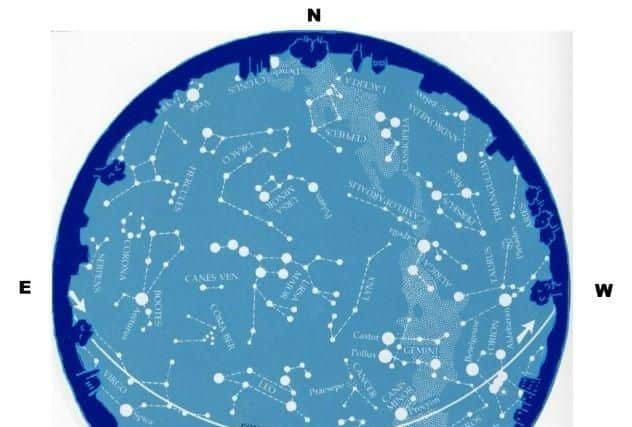
The Star Chart
The sky will look like the chart on March 21 at 8pm. And four minutes earlier on each successive night e.g. 8.56 on March 22.
Skynotes
Please note all times given in this article are in GMT which is the current time until the end of the month.
Sun: From the beginning to the end of March, the hours of daylight increases from 11 to 13 hours. The Spring or Vernal Equinox (the day when night and day are of equal length) occurs on March 20. The cocks go forward by one hour to British Summer Time at 2am on March 26.
Mercury: Mercury is not visible for most of March as it reaches Superior Conjunction (on the opposite side of the Sun from the Earth) on March 17.
Venus: Venus is an evening object in the background constellation of Pisces, seen low in the south-western sky. At the beginning of the month it sets about two hours after the Sun and by the end of the month will be in the sky almost three-and-a-half hours after the Sun. Through a telescope Venus shows phases like the Moon. Venus is easily the brightest object in the sky after the Sun and the Moon and is often confused with man-made light sources when seen low in the sky.
Mars: Mars is still seen against the background of Taurus at the beginning of the month but moves into the background constellation of Gemini by mid-month. Mars is now moving away from the Earth and so is getting much smaller and more difficult to view, even through telescopes. Views of the red planet will again improve towards the end of 2024.
Jupiter: Jupiter now lies low in the western sky and also against the background of Pisces. The low altitude makes it less easy to see details but the planet and its four largest moons can still be viewed with binoculars or a telescope. Jupiter lies very close to Venus at the beginning of the month and very close to Mercury at the end of the month, providing a couple of interesting photo opportunities for observers with a DSLR camera.
Saturn: Saturn is no longer easily visible.
Uranus and Neptune: Uranus is seen against the background stars of Aries and close to the Pleiades star cluster. At magnitude 5.8, it is visible in binoculars. Look for a tiny greenish disc compared to the pinpoints which are the stars. Neptune is in conjunction with Sun and is not visible this month.
Meteor showers: There are no regular meteor showers this month. However stray or sporadic meteors can still be seen at any time. Some of these can be very bright.
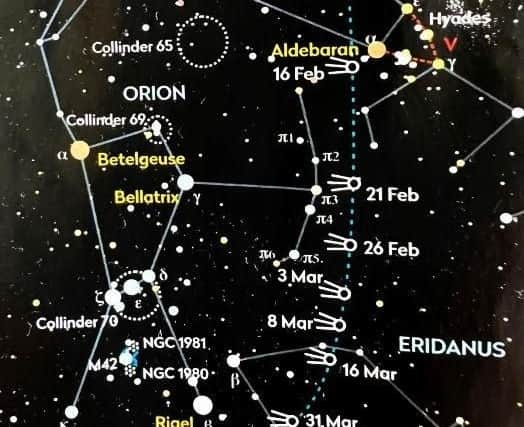
The Full Moon occured on Tuesday, March 7, with Last Quarter on March 15, New Moon then follows on March 21 and First Quarter on March 29.
Data supplied by Simon Harding, Observations Secretary Torbay Astronomical Society
Diary Dates
The next meetings of Torbay Astronomical Society will be held at Torquay Boys' Grammar School, Shiphay Manor Drive, Torquay. On March 16, TAS member Richard Mayo will give a talk entitled Dark Matter is Quite Ordinary. And on March 30, an observational evening will be held when members will be delighted to provide views of the objects discussed in this article. In the event of bad weather, short talks and videos will be presented alongside informal discussion and an opportunity to get to know the society. For details, contact the secretary of TAS by email to [email protected]. Visitors and prospective members are especially welcome.