

June night skies: Twilight that never quite ends and the constellations of Hercules
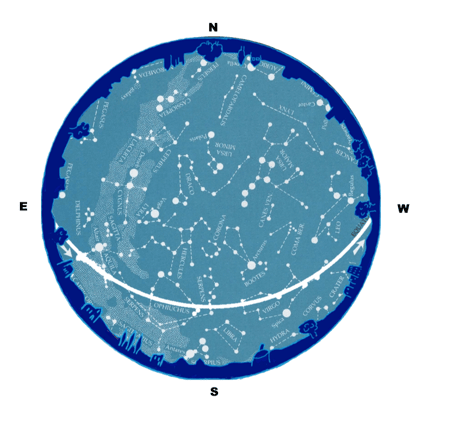

Stargazing with Torbay Astronomical SocietyStorytelling with the stars.
June is the month when Astronomical Twilight never ends and so the night sky is never really dark.
Astronomical Twilight is defined as when the Sun lies between 12 and 18 degrees below the horizon.
True night with dark skies occurs only when the Sun is more than 18 degrees below the horizon.
The Summer Solstice occurs on June 21 st , although the longest day is actually on 20 th , when we will
have over 16 hours of daylight! The Sun is still near the maximum of its 11 year cycle so, if you are
able to safely observe the Sun, either with a purpose-built solar telescope or by projecting an image
through binoculars or a telescope onto a screen, you should see plenty of sunspots. The solar
maximum also increases the chances of our seeing the Aurora or Northern Lights from lower
latitudes.
The late Spring/early Summer skies contain a number of constellations which have their origins in
the stories of one of the great heroes of the Ancient World. The constellation of Hercules can be
seen almost overhead during June. The readily identifiable asterism (a shape within the
constellation) of the “Keystone” stands out. Scanning the Western (right-hand) side of the Keystone
with a good pair of binoculars will reveal a bright fuzzy patch. This is the object known as M13 in
Messier’s Catalogue, although it was discovered by Edmund Halley (of comet fame). It is bright
enough to see because it consists of stars. It is a special kind of star cluster known as a “Globular
Cluster” because of its shape. It is a ball of, maybe Half a Million, stars that orbits around the centre
of our Galaxy. There are many such Globular Clusters associated with our Galaxy and we have
observed similar clusters associated with other galaxies.
In traditional pictorial representations, Hercules is always seen upside-down. This represents his
emergence from the Underworld after completing his 12 th Labour – taming the three-headed dog
Cerberus. In fact, Cerberus was identified as a separate constellation within, what is now Hercules,
during the 17 th and 18 th centuries.
The constellation of Leo, seen in the West, is said to represent the Nemean Lion, the subject of
Hercules’ First Labour. The preceding constellations of Cancer and Taurus are also, sometimes
related to Hercules. Taurus may represent the Cretan Bull which he was sent to capture whilst
Cancer represents a crab that was sent to distract him from completing yet another Labour, by Hera,
the goddess who had instigated the tasks.
That Labour was the defeating of the Lernean Hydra. Hydra is the constellation hugging the South-
West horizon, and represents this mythical monster. Hercules had to cut off the many heads of this
creature in order to defeat it. However, every ime one head was severed, two more grew in its
place. Our hero had to decapitate the head and then cauterize the wound before it was replaced.
This is where the crab comes in, trying to distract Hercules from completing the task successfully.
However the unfortunate crustacean was crushed underfoot during the struggle. Hera then placed it
in the sky as a reward for its loyalty to her.
The rising Summer constellations seen in the Eastern sky, Aquila(the Eagle), Cygnus (the Swan) and
Lyra (the Lyre, but used to be known as The Vulture) are also connected to the myth of Hercules. In
one version of the tradition, they represent the Stymphalian Birds, the subject of another of the
hero’s Labours.
These stories demonstrate the real reason for the constellations. They are seasonal, visual reminders
to the storytellers of an oral tradition dating back thousands of years. Today we do not always see
how the shapes in the stars manage to represent their namesakes, but we still remember the
stories.
Also in our skies at the moment we can see the constellation Corona Borealis, just to the West of
Hercules. This constellation is formed by a distinct curve of stars. At the time of writing, astronomers
are still awaiting the nova event predicted for the star T corona Borealis. This star is of a type that
undergoes repeated nova-like explosions, brightening by some 10 orders of magnitude, and so the
star has been under careful scrutiny for many months. No less than four prediction deadlines have
been passed with no sign of change in the star. We are currently within a prediction parameter that
runs from “mid-February 2024 – September 2026” however, there was also a prediction made in
1946 that the so-called Blaze Star would erupt again in 2026-2027. We will just have to keep all eyes
on the sky and hope that it is not cloudy when it eventually happens.