

'The high street has been in decline for decades': A Torquay jeweller reflects on 50 years of change
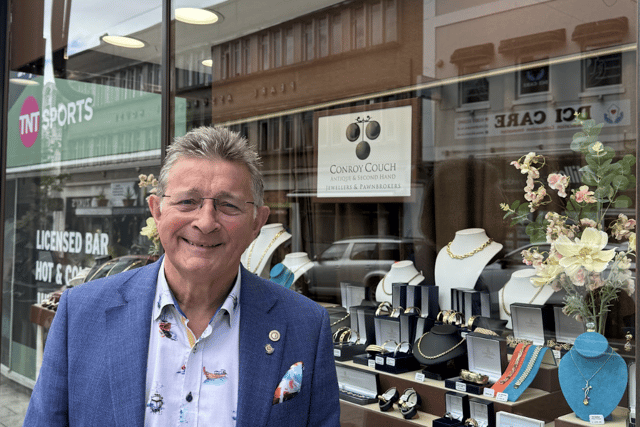

David Rowe has witnessed Torquay's retail transformation firsthand. From family-run traditions to changing shopping habits and personal loss, he shares the story behind one of the town's best-known jewellery businesses.
For more than half a century, David Rowe has been a familiar face in Torquay’s jewellery trade. As the owner of Conroy Couch Jewellers and joint owner of Regina Rowe Jewellers, alongside his former businesses Gordon Rowe Jewellers and Pandora Torquay, his working life has been deeply tied not only to the fortunes of the town centre, but to the people and personal moments that shaped it.
But his story begins long before today’s high street, in a very different era of retailing, one where jewellers often carried multiple professions under one roof. “Jewellers were opticians as well back then,” he says, pointing out an old sign that still reflects that history. “You can actually see it written there. It was very common. My grandfather was the same in Oswestry, Shropshire, he was a jeweller and an optician. It was a proper family trade in those days.” That sense of heritage runs through everything David Rowe has done. Born into the business, he joined the trade in 1971 after his father fell seriously ill, a moment that unexpectedly changed the direction of his life. “I left school at 17 and I was meant to go into training with House of Fraser in Plymouth,” he recalls. “But my mum said, ‘Come and help in the shop over the summer while your dad recovers.’ I never really left.”
What started as a temporary arrangement quickly became a lifelong career. He was drawn to the craft, the pace, and the personal nature of the work. “I just enjoyed it,” he says. “Handling jewellery, displaying it, talking to customers, it felt natural. I didn’t plan it, but I couldn’t really see myself doing anything else.” By the early 1980s, David and his wife Regina had taken the significant step of buying the business from his parents. It was a defining moment, but also a period of financial risk, with interest rates high and uncertainty across the economy. “We didn’t have the money,” he says frankly. “We had to borrow everything. We were mortgaged up to the hilt; the house, the business, everything. It was very tough. There were times when you just had to get on with it, because there wasn’t really another option.” Together, they rebuilt and modernised the business, focusing on higher-quality stock and a stronger customer experience. Regina played a central role, particularly on the financial and administrative side, while David focused on customers and buying. “She was incredibly bright,” he says. “She had a real head for business. She did all the bookkeeping, learned gemmology, and understood the trade inside out. We built everything together.” Their partnership extended beyond business into family life, raising two daughters while running a demanding high street enterprise. But over time, opportunity also came in unexpected forms. One of the most significant was the acquisition of Conroy Couch Jewellers, a long-established rival directly opposite their original shop. “That was a big moment,” he says. “It had been there since 1864. It was well known in the town. We took it on as a going concern; staff, stock, everything and that really changed the direction of the business.”
Conroy Couch became known for second-hand and pre-owned jewellery, repairs, and pawnbroking,a side of the trade David says is often misunderstood. “Pawnbroking is about short-term support,” he explains. “People come in, they need £200 or £300, and they use jewellery as security. The idea is not to lose it. Most people redeem it. It’s a way of bridging a gap when there’s nowhere else to go.” In time, another major opportunity arrived in the form of Pandora. “Pandora came in with just a couple of trays at first,” he says. “Silver charms, bracelets and it just exploded. We opened Pandora Torquay in 2014.” The brand quickly became one of the strongest performers in the town, with demand exceeding expectations. “It was unbelievable,” he says. “Within a few years, we were one of the best-performing Pandora stores in the UK. It completely changed that part of the business.” But behind the commercial success, life brought devastating personal loss. In 2019, Regina was diagnosed with terminal cancer and passed away only weeks later. “That period was incredibly hard,” he says quietly. “We had built everything together. Suddenly she was gone. It leaves a huge hole, not just personally, but in how you run a business and your day-to- day life.”
In the months that followed, it was his youngest daughter, Michelle, who stepped in to help. “She was on maternity leave at the time,” he says. “And she just said, ‘I’ll help you.’ She came into the business and took on the bookkeeping and administration. It really kept things going when I wasn’t in a good place.” He pauses before adding: “Without her and my amazing teams of staff, I’m not sure we would have got through that time in the same way.” As the business adapted, the family dynamic shifted too. Michelle eventually became a key part of the operation, working alongside her father to run Conroy Couch and Pandora Torquay. “It just worked,” he says simply. “We’ve always got on well, but and it gave the business stability again. In fact, it led to the creation of Regina Rowe Jewellers, driven by my daughter and creating a legacy to my wife and her mother.” Like many independent retailers, Rowe has also had to navigate a rapidly changing town centre. He is candid about the pressures facing Torquay.
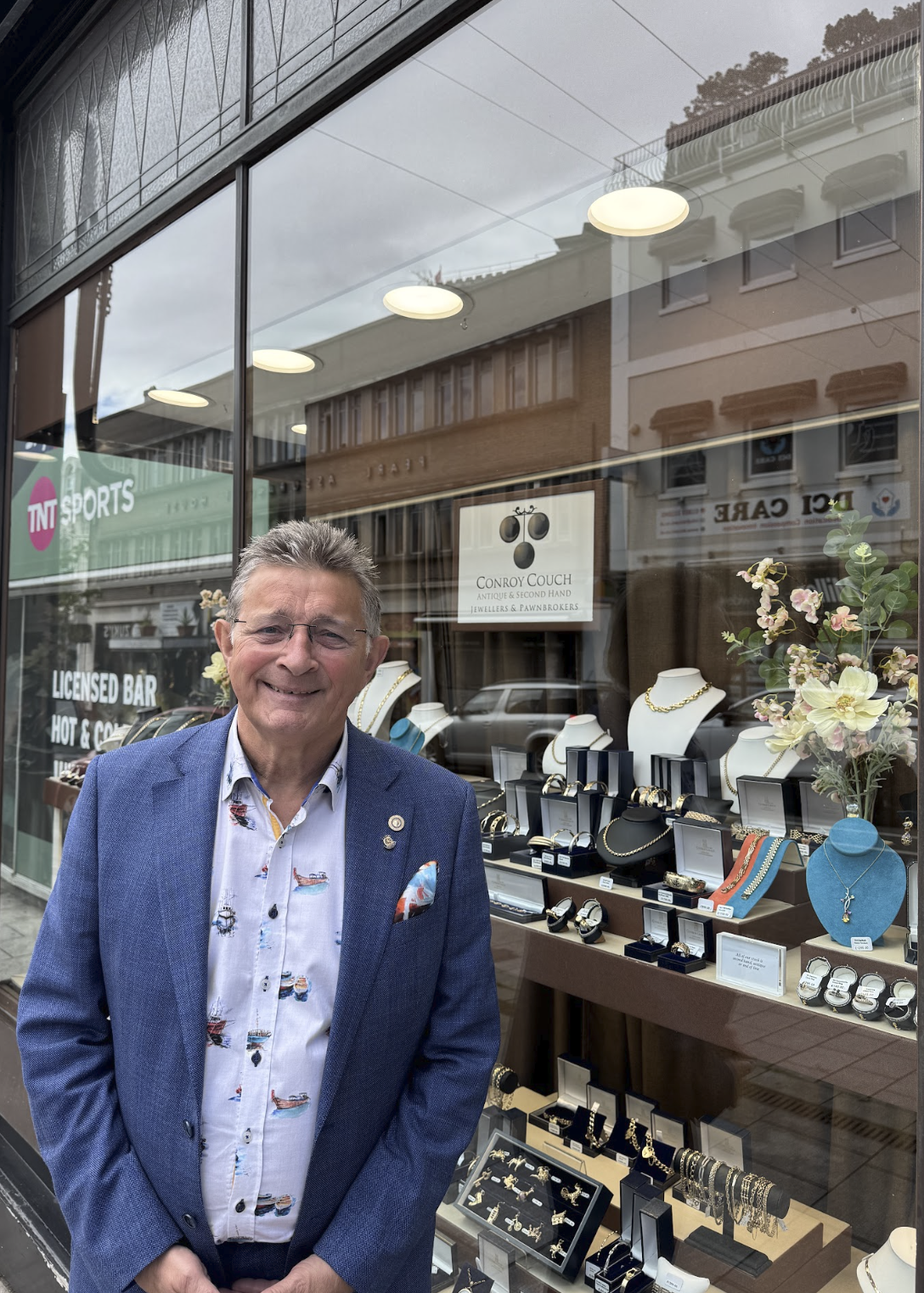
“The high street has been in decline for decades,” he says. “Out-of-town shopping, online retail, planning decisions, it’s all had an impact.” He points to developments such as the Willows retail park and Union Square as key turning points. “Once footfall moves, it’s very hard to bring it back,” he says. “You need a proper plan for regeneration, not just demolition.” Despite that, he has remained committed to the town, taking on roles in local business groups and community organisations, including Rotary and the Town Centre Partnership.
“I’ve always believed in giving something back,” he says. “You can’t just operate in a town, you have to be part of it.” In recent years, he has also rebuilt his personal life and social circle after loss, something he speaks about with quiet honesty. “You have to rebuild in your own way,” he says. “Work helps, community helps, meeting people helps. You don’t just switch off and move on- you adjust.” Looking ahead, David remains cautiously optimistic about Torquay’s future, particularly if investment is delivered in a more joined-up way. “Torquay is still a fantastic place,” he says. “It has tourism, it has wealth, it has history. But it needs direction.” After more than 50 years in the trade, he is still very much part of the day-to-day running of Conroy Couch. “I still enjoy it,” he says. “As long as you’ve got good people around you, and customers who trust you, that’s what keeps you going.”