

Lifeboat exercise triggers 'ship on fire' 999 call
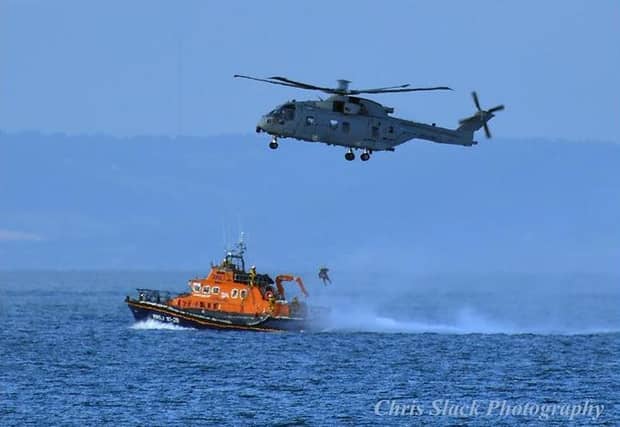

RNLI Torbay completed a series of air sea exercises involving Royal Navy Merlin helicopters and the Bay’s Severn Class all-weather lifeboat. At one stage the exercise triggered a 999 call from a member of the public who thought there was a ship on fire.
RNLI Torbay completed a series of air sea exercises involving Royal Navy Merlin helicopters and the Bay’s Severn Class all-weather lifeboat.
At one stage the exercise triggered a 999 call from a member of the public who thought there was a ship on fire.
The exercises were an opportunity for both services to train and practise close air sea operations in both daylight and night-time conditions.
It allowed Royal Navy pilots to add some low level airtime experience linking up with vessels while underway and to undertake high-line transfers between aircraft and lifeboat.
This can be essential when right out at sea and medics need to transfer from helicopter to treat casualties on board, or when casualties need to be airlifted from a lifeboat and flown at speed to on-land hospital facilities.
A high-line operation involves a rope being lowered from the helicopter, caught, and maintained by the crew, which in turn facilitates the winching down of a person safely on to the deck.
From Torbay’s distant beaches, the downdraught of the rescue helicopter’s blades in the evening haze could be mistaken for smoke, and indeed, a ‘ship-on-fire’ was reported by a concerned onlooker to Solent Coastguard resulting in a request being channelled to Torbay lifeboat station to investigate and assist. Understandably the crew were on site instantly, and able to report back that all was well!
Mark Criddle, Torbay RNLI’s coxswain, said: ‘The training exercise was a great success. We are always grateful for the opportunity to work with RNAS Yeovilton and especially under night-time conditions because it all helps to hone our effectiveness when we are operating 20 plus miles out at sea.”