

Kevin Dixon: Torquay’s London Bridge
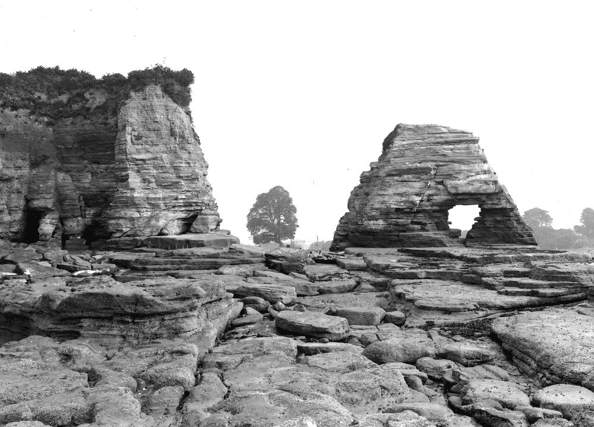

Not far from Torquay Harbour is a natural arch called London Bridge. There’s a bit of a debate here as many local locals just call it ‘Natural Arch’. And it certainly is a natural arch, formed where a less resistant Middle Devonian limestone cliff has been eroded by the sea.
It wasn’t the only arch in Torquay, however. There was another one called Mitre Rock at Corbyn Head. A tourist attraction, it consisted of far softer Permian Sandstone and finally succumbed to the waves in the 1950s.
But why call our natural arch London Bridge?
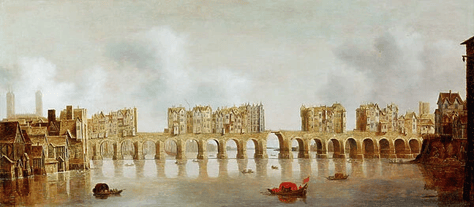
But London Bridge just doesn’t look like the Thames River crossing that the Victorians and Edwardians were familiar with. Recognising this incongruity, in 1832 Octavian Blewitt in his ‘The Panorama of Torquay’ called London Bridge an “absurd appellation”. Torquay historian Arthur Charles Ellis suggests that “The explanation for the name often given is that it comes from the same granite as London Bridge”. Arthur fails to point out, however, that our arch is limestone and not granite.
Octavian’s observation was correct. There isn’t much of a resemblance to the fine London landmark that he had seen. This was the New London Bridge which opened in 1831. It was 928 feet long and 49 feet wide and based on five wide stone arches.
Incidentally, the New London Bridge was constructed from Dartmoor granite. Spare corbels, the stone brackets which carried the weight, were left behind at Swelltor Quarry. They still lie beside the former narrow-gauge Plymouth and Dartmoor Railway.
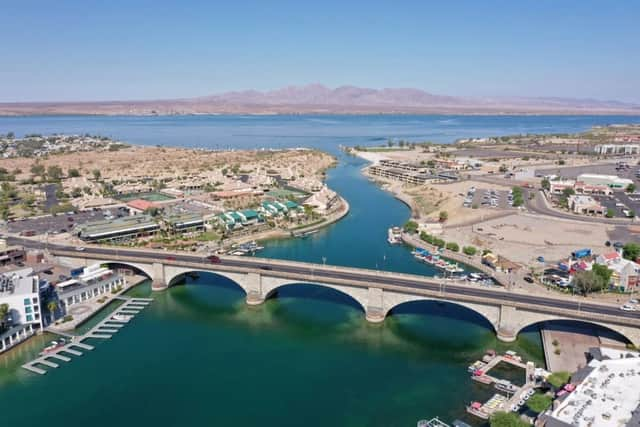
This is the bridge that was dismantled in 1967 and relocated to Lake Havasu, a planned community established in 1964 beside a lake in Arizona. A little bit of Dartmoor in the desert.
But what if our arch was named after a much older London Bridge?
There is a Torquay map made by Matthew Blackmore in 1769 which features the ‘London Bridge’.
It had nine membranes of parchment, about six feet square and was “practically perished” even back in the early nineteenth century. The map was described as being “within an ornamental border surmounted by a parrot with extended wings; and below showing an illustration of fruit, plan of the manor of Tormoham in the said parish and property of Robert Palk esquire”.
The original Old London Bridge began construction in 1176 and was finished in 1209 during the reign of King John. The bridge was some 26 feet wide, and about 900 feet long, supported by 19 irregularly spaced arches. It had a drawbridge to allow for the passage of tall ships, and defensive gatehouses at both ends.
By 1358, it was already crowded with 138 shops. By the Tudor era, there were 200 buildings on the bridge, some seven storeys high, which overhung the river by seven feet.
The bridge was “for wise men to pass over, and for fools to pass under.” Some were drowned attempting to do so.
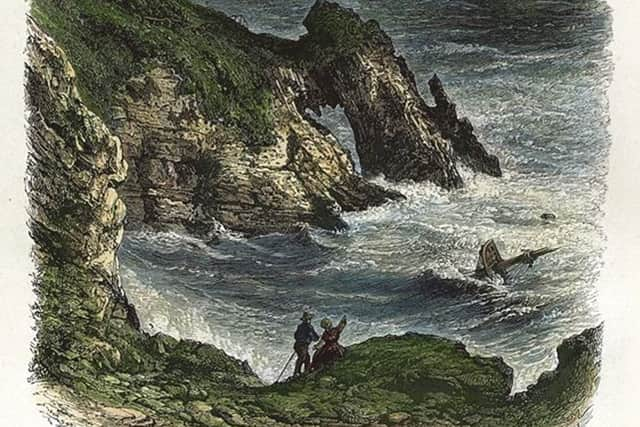
Navigating a small boat near the cliffs by Torquay Harbour can similarly be a dangerous undertaking. Reinforcing the hazardous nature of the area, there’s a nineteenth-century print showing a ship sinking by Torquay’s arch.
Hence, was our London Bridge named by someone who had seen the narrow irregular arches and hazardous tidal rapids of the medieval London Bridge? We’ll never know for sure. What we do know is that we have a striking local landmark with an unusual name.