

Kevin Dixon: Māori artefacts and vampire killing kits sold by Torquay dealers

Local historian Kevin Dixon's latest dive into the Bay's intriguing past
Remarkable as it may seem, not all of Torquay’s residents are honest and upstanding.
Indeed, over the years we seem to have produced some quite dishonest individuals, none more so than James Edward Little (1876-1953).
James was a Torquay antiques dealer and restorer who also specialised in selling Māori and Polynesian artefacts. The issue was that they weren’t genuine Māori and Polynesian artefacts.
As a young man, James had become an antiques dealer and a skilled restorer of old furniture.
To help with the bills, his wife let lodgings during the summer months, and it was due to a guest in their home that James began his criminal career.
In 1900 a London art dealer named JB Russell stayed at the Little’s home. Russell came upon some Pacific and Australasian curios and offered to sell them for James. A profitable little business then followed. This may have given James the idea to embark on a new business venture.
James placed advertisements in the Exchange and Mart newspaper, and he soon had a string of serious collectors as clients. In fact, James began one of Britain’s first antiques mail-order businesses.
The only problem was that he had never set foot in the South Pacific.
James was one of Europe’s most notorious art forgers with a specialism in knocking up and selling Maori artefacts.
He went on to fool scholars and museum directors across the world, including the Chicago Field Museum of Natural History. The great Pacific art collectors of the early twentieth century were all taken in by James.
He even sold fakes to experts and collectors in New Zealand, where the pieces were supposed to have come from in the first place.
All believed that his forged or stolen artefacts and their associated documentation were real examples from New Zealand’s indigenous peoples, rather than from the back room of a dodgy Torquay dealer.
James's best forgeries were often copies of authentic Maori art.
He would steal these from museums, replace them with fakes, copy the pieces, and sell the originals on. This went on for decades. He preferred to do all his transactions through the mail, so none of his clients ever saw him, even though they may have been dealing with him for over a decade.
However, while a quite brilliant forger, James wasn’t a master criminal.
In 1915 he stole a decorated Māori wooden box from a Wiltshire museum, substituting the original for one of his fakes.
The swap was noticed, and James was tracked down. He had signed the visitors’ book at the museum with a false name, but he was the only visitor the museum had in three days. He was arrested and sent to prison for six months.
He went to prison again in the 1930s for attempted theft from museums and auction houses. Yet, ironically, James was never convicted of forgery, the crime for which he became notorious.
Just as James remained an anonymous and distant figure to all he conned over those many years, so he remains to us. Sadly, there appear to be no photos of James Edward Little, and no description of him exists.
Our second example is of a Torquay antiques dealer who possibly created something that probably never existed in the first place.
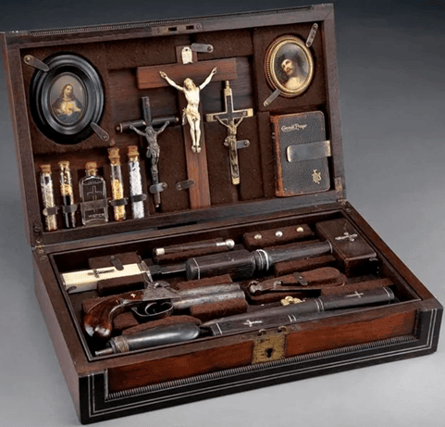
Today, vampire killing kits can be bought at auction or on the internet, often for thousands of pounds.
What isn’t absolutely clear is if these kits are actually real antiques designed to fend off the undead, novelty items, or just modern fakes?
They usually contain, as can be expected, a crucifix, stakes, holy water and a pistol.
They’re not even particularly rare. The Ripley’s Museums of Oddities, for example, have 30 of them on display in their museums.
The claim is that the original vampire-killing kits were for travellers to Eastern Europe in the late nineteenth century. This would have followed the book and theatre productions of Bram Stoker’s ‘Dracula’.
Yet, most evidence now points to an American or Western European origin at some time during the twentieth century.
On inspection, most have turned out to be compilations of historical artefacts that found their way into the antiques market during the 1970s or 1980s.
Indeed, the first printed reference to the existence of the kits seems to be in the October 1989 issue of ‘Guns & Ammo’ magazine, where one was on sale at an American gun show.
When Delaware’s Winterthur Museum had one kit analysed, the results found that the paper labels were of twentieth-century origin, which had been artificially aged.
Furthermore, the ‘silver bullets’ contained were actually pewter. Even the inclusion of silver bullets to kill vampires doesn’t even make sense. Silver, as any genuine supernatural slaughterer would know, is only truly effective against that other paranormal pest, the werewolf.
Here’s the Torquay connection.
Some of the nineteenth-century vampire-killing kits on the modern market are attributed to a Professor Ernst Blomberg and the ‘Liege gunmaker’ Nicholas Plomdeur.
Rather than being the genuine article, however, responsibility for the creation of Ernst Blomberg has been claimed by Torquay’s Michael de Winter.
The opportunistic Michael came into possession of some poor-quality antique firearms. He was an antique dealer and would often acquire bits and pieces that had little value in themselves.
Putting them all together as vampire-killing kits to cash in on the popularity of the Hammer movies was therefore an astute move.
In 2004 Michael stated that he started marketing his kits in the 1970s and that others then copied him.
Michael tells us, “The whole VAMPIRE KILLING KIT myth is purely the result of my very fertile imagination, and I produced ‘The Original’ in 1972. Nicolas Plomdeur, the gunsmith in Liège, and Professor Ernst Blomberg are not and have never been real people. I still have an original copy of the label from the box and am astounded to learn how my joke has caused so much interest and ‘FAKERY’.”
So, that’s settled then. They’re all fakes.
This is, however, where it gets intriguing.
Other vampire ‘experts’ have dismissed Michael’s story.
One kit owner claims he bought his at an auction in 1969, three years before Michael was supposed to have invented the artefact. Also, despite Michael’s claim that he invented Ernst Blomberg and Nicolas Plomdeur, there actually was a nineteenth-century professor and Belgian gunmaker with those names.
Of course, this could all be a disinformation exercise by the vampires themselves in an attempt to stop us paying thousands of pounds for an essential piece of protection. This clever ruse by the bloodsuckers would then leave us all effectively defenceless when they come a-calling.
We conclude this article by reminding readers that, regardless of what you may have read above, Torbay’s antique dealers are, on the whole, honest and upstanding members of the community.