

Ian Handford: Torquay vicar on religious collision course with Bishop

The stories behind Torbay's blue plaques by Ian Handford, chairman of Torbay Civic Society: Although part of this man's story was told in the Church of St John The Evangelist, Higher Terrace article, it featured mainly the blue plaque at the church and i
The stories behind Torbay's blue plaques by Ian Handford, chairman of Torbay Civic Society:
Although part of this man's story was told in the Church of St John The Evangelist, Higher Terrace article, it featured mainly the blue plaque at the church and its designer George Edmund Street and later his son, also another George.
Today, I concentrate on vicar William George Parks-Smith born in 1804 and ordained a priest at Exeter in 1834 who locals today still call 'Flowerpot Smith'.
Churchman Parks-Smith was licensed to be an assistant to Rev Domett and a year later married his daughter Elizabeth.
With the death of Rev Domett, his successor did not require an assistant and so Parks-Smith left. Fortunately, the Very Rev William Mallock, patron of St John, then nominated Parks-Smith for the 'office of curate of the perpetual curacy of the endowed Chapel of Torquay in the parish of Tormohun'.
Now the powerful Lord Bishop of Exeter controlling a diocese of four counties confirmed Williams appointment in July, 1837, making him curate of Torquay's small Chapel of Ease which decades later was to become Church of St John the Evangelist.
The original chapel was established in 1822 when it played only a minor role in Torquay, holding two Sunday services weekly and having no parochial responsibility, no font and no licence for formalising marriages.
Sitting on St Johns Hill, the small chapel was used to teach mainly doctrine and the principles of the established Church of England to children.
Yet unknown to Bishop Phillpotts, its curate had leanings towards Rome and followed the practices of Keble and Pusey with their commitment to Catholicism.
It was soon very clear that Rev Parks-Smith and Bishop Phillpotts were on a religious collision course.
Rev Parks-Smith never actually celebrated Holy Communion but his many 'innovations' were already transgressing tradition.
One topic even went national when a Times reporter in February, 1845, wrote of the ceremonials at Torquay as being 'obnoxious changes being introduced - when at the parish church no such alterations to services have taken place'.
The Times reported later that worshippers at the Chapel of Ease had even been witness to their Bishop sweeping flowerpots and flowers from the alter and the Chapel Cross. as he saw these transgressions as serious which started a legal battle which ended in the first ever 'national ritual prosecution'.
Admonishing Parks-Smith for his 'innovations', the Lordship then warned him 'to not again offend in the like manner, and I further order that you pay for the cost of these proceedings'.
But three years later Parks-Smith was at it again, this time leading to an Order of the Church Council. But he had had enough and now fled Torquay to enlist as a chaplain in the Crimean War. A year later he was back and strangely was welcomed by the Bishop, who re-instated him as parish vicar.
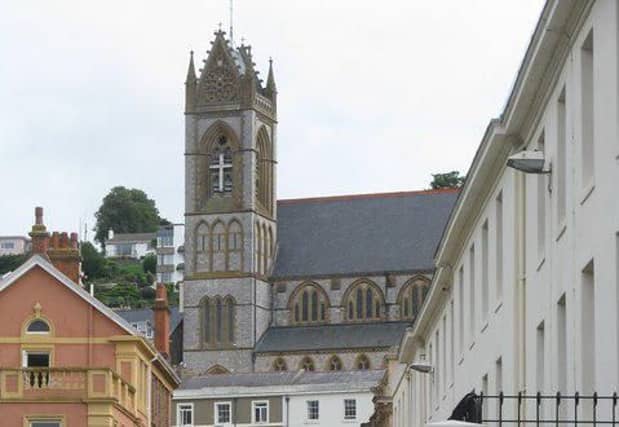
But now Rev Parks-Smith commissioned George Street, a known Catholic, to demolish and rebuild his church in the Georgian style. It was all a step too far for Phillpotts who, in November 1864, finally refused permission for the new church to even open.
It was some years before St Johns was opened in 1871, by which time both George Street and his Lordship were dead. It would to be George's son George that built the new tower with its illuminated cross.
Rev Parks-Smith will always be remembered as 'Flower Pot Smith', due to religiously sticking to his principles.
Yet having served his Torquay congregation for 30 years, he finally retired immediately after the formal opening of his new church and eventually died at Brighton in 1886.
This more than extra-ordinary life should to my mind be worthy of remembrance, perhaps by commemorating the churchman Rev William George Parks-Smith by the unveiling of a blue plaque at his church at Higher Terrace, Torquay.