

Ian Handford: The small chapel that was to shine bright over Torquay
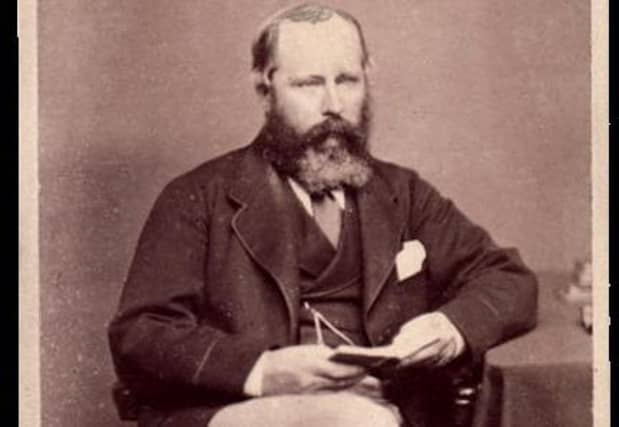

This week we celebrate the blue plaque for George Edmund Street at St John the Evangelist Church. The early 19th century map saw Torquay as an insignificant fishing port called Tor Key. Yet, the internationally-famed architect George Edmund Street would
This week we celebrate the blue plaque for George Edmund Street at St John the Evangelist Church.
The early 19th century map saw Torquay as an insignificant fishing port called Tor Key. Yet, the internationally-famed architect George Edmund Street would eventually be commissioned to rebuild a small Chapel here on the Terrace, which he turned into the “Church of St John the Evangelist” that we still see today.
With Torquay’s population having doubled by 1810 and with sufferers of glandular fever moving from the North to live near the sea, the new population soon doubled again, and this time many of the incumbents chose to live in or near Torquay town centre, where they then questioned where they might worship.
It is difficult today for us to imagine the importance the Church played in the lives of Victorians but it does perhaps explain why, on May 1, 1822, the foundation stone of the small Torquay Chapel was first laid. The new Chapel of Ease (as it was known) would eventually be turned by Mr Street into the significant Church of St John the Evangelist, although not yet sporting its tower with an illuminated Cross we all view today.
Mr G. E. Street was born in Woodford, Essex and eventually he became a leading practitioner of building Victorian Gothic architecture. His work took him around the world, becoming famous for his designs, which generally involved ecclesiastical architecture. In London, however, George found time to design and create the Royal Courts of Justice on the Strand, while being involved in literally hundreds of church projects.
It was after his father died that, together with his mother and sister, he lived in Exeter until, in 1841, George went to work as a pupil at the offices of Owen Browne Carter in Winchester. On his return to London, he became an improver at the George Gilbert Scott business in the City.
His first commission was the Biscovy Church in Cornwall and then, within five years, he had started his own practice to specialise in Church restoration. Quite how he was picked for the commission at Torquay is unknown, although we do know he had already designed more than a dozen Churches in the City of Oxford before his return to London in 1855.
Meanwhile in Torquay, a local battle was raging between the Curate at the Chapel of Ease, the Rev William G Parks-Smith, and the Anglican Bishop of Exeter, Bishop Phillpotts, who for decades was seen as the most powerful man in the Westcountry, overseeing a Diocese stretching from Dorset to the Isles of Scilly.
In Torquay, Rev Parks-Smith as first Curate was, from the outset, a controversial figure. He was seen as an innovative Churchman (almost High Church). Though the Bishop had appointed him, he soon found him intolerable.
Phillpotts was an absolute traditionalist and now endless dispute arose, which eventually ensured Parks-Smith fled Torquay to enlist in the Crimea War as Curate. He fortunately survived and then returned to Torquay and, amazingly, Phillpotts (quite out of character) re-appointed him, while also giving him permission to reconstruct the now popular Chapel into a new Georgian Church, which was to be renamed St. John the Evangelist.
Parks-Smith commissioned George Edmund Street to be his architect, a man known to have High Church sympathies. Now, Street’s sculptured and decorative finishes all became too much for the Bishop and he eventually refused to allow his permission for the Church to open formally in 1864.
It took two more years before consecration came, though by then Parks-Smith had moved on and George was dead. It was George’s son – Arthur Edmund Street (also an architect) who finally completed the distinctive tower of today.
Our Blue Plaque honouring George Edmund Street and ST JOHN THE EVANGELIST CHURCH was unveiled by us in partnership with Torbay Council in 1989, one hundred years after Arthur had published his father’s biography.