

Ian Handford: The prolific engineer behind much of our seafront environment

Henry Augustus Garrett, born in 1859 was by the age of twenty being appointed assistant surveyor to Bournemouth Council. Yet by 1890, he would move to Torquay after being appointed Harbour Engineer and Surveyor. He now discovered his adopted town was very ripe for expansion having earned a reputation nationally, as the leading watering spa of the South West.
Prior to his arrival, the Torquay Council had applied to Parliament for permission to construct a Pier "The Torquay Pier and Harbour Provisional Order Bill", which had become law on August 7th 1888. With its foundation stone laid by the seventeen-year-old Princess Marie Louise on May 5th, 1890, Henry was already investigating piers around all rival coastal resorts, and in October 1891 he agreed that the Council ought to build a new pier. A second Bill was laid before Parliament before the Provisional Order of 1892 and was finally approved by the Torquay Council on May 17th, 1893. Meanwhile, a proposed Pavilion was still in limbo, heavy storms in 1891 had involved huge expenditure on existing groins which had been replaced delaying any start on the new Esplanade and pier or Pavilion.
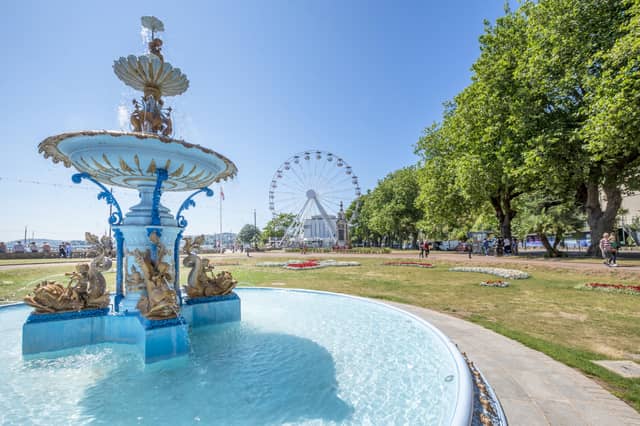
Now Henry designed the Royal Terrace Gardens (today's Princess Gardens and Terrace Walk), as he saw these as emphasising the importance of a new pier. His work was complete by 1895 and with the electorate recognising their new engineer's vision of ambience and style, the town adopted the name "Queen of the English Riviera".
From his arrival, Henry had wanted a covered promenade. Still, noting the many blocking motions of the Council, it took him five years before calling a public meeting held at Torbay and Cumpers Hotel on January 27th 1899 about Torquay's future. The report on this said "that in the opinion of this meeting, it is advisable that a building should be provided in this town wherein musical and other entertainments may be given for the recreation of visitors and residents" - his wish achieved the esplanade and Pavilion would go ahead.
Henry was more a Civil Engineer than an architect, so now concentrated on reclaiming the tidal muddy area at the inner harbour which was delaying his Esplanade. Sadly, there was still no clear vision of why a Pavilion should be built (same problem- today) even when Henry suggested a roller skating rink, the idea remained just an idea. Meanwhile, concerts were held under canvas until a bandstand appeared on the Pier, while Henry's workload became absolutely astonishing. He built a refuse destructor at Upton Valley while working on Esplanade Road and new sewers between Torbay Hotel and Dyers Cottage (the Toll House) all by 1898. The Pavilion Theatre's foundation stone was not laid until July 26th 1911, leaving time for him to oversee its completion just before he was called to the First World War. Having joined the Army Corps as a G.R.E at Plymouth he was transferred to Salisbury HQ as Officer in charge of Roads and Communications of Southern Command. Becoming a Major in the Royal Engineers he kept the role even after the war on his safe return to Torquay in 1918.
Now completing literally hundreds of projects before in 1930, Major Henry Augustus Garrett finally retired. Having lost his wife in 1933 he died aged seventy-three at his "Kingsdale" home on Babbacombe Road in May 1934. Two daughters survived him.