

Ian Handford: The D’Oyly Carte family and life in South Devon

THIS feature commences with Richard Carte, father of Rupert and a partner in Rudall, Carte and Company with Blanche his wife Richard had adopted the ‘D'Oyly’ from his mother’s maiden name perhaps wishing to have an accent on his name as a showman. Critics later called him a ‘calculating business showman’ and ‘Oily Carte’ due to his many deals - which to me seems a little unfair.
Richard had married a 17-year-old, Blanche Prowse and together they had a concert agency with clients like Oscar Wilde, the tenor Lanza and eventually from the G/s Operetta's fame, the writer William S. Gilbert and music partner Arthur Sullivan. Richard soon created a three-man partnership so that the family business could produce all the Gilbert and Sullivan operetta's while at home he produced two sons - Lucas and Rupert.
Years of ill-health saw Blanche die of pneumonia in 1887, a time when Richard was in America with friend Arthur Sullivan. She had been convalescing in a house near the Thames and not at the family home in Bloomsbury.
Nevertheless, Richard chose not to return for her burial in the family vault at Old Highgate Cemetery but had arranged for his boys to be looked after by his sister Lizzie, who returned them to their Winchester Boarding School after the funeral. Older brother Lucas would eventually become a Barrister and take no part in the family business while Rupert became a Director at 27 and later Chairman of Savoy Hotels on inheriting the family business through his then stepmother Helen Lenoir.
Rupert and Dorothy, his wife, eventually sailed to Devon in their yacht to discover a seashore site suitable for a second home between Torbay and Dartmouth. Rupert was born on November 3rd 1876 and from an early age was always rich which especially applied after becoming an impresario and hotelier. Having lost his mother when 11 he would inherit all of the family businesses through his stepmother Helen Lenoir before being sent on special duties with the British Navy until the end of the First World War.
On his return he ran all of the family's businesses from 1918. His father had long dreamed of building a Savoy Theatre and when it was completed, it became the first theatre to be lit by electricity when on opening in October 1881. It was highly successful and remained so until Richard's friend and partner Sir Arthur Sullivan died in 1890, the era from which Richard never recovered and by April 1901 died himself.
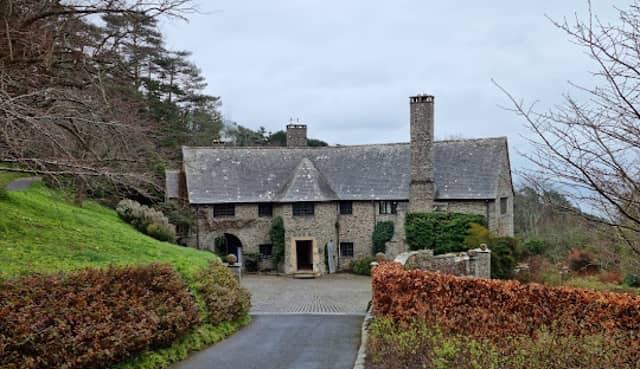
It would be during 1925 that Rupert and Lady Dorothy first came along our coast in their yacht and found Dudcombe Cove with its beautiful land above. Immediately smitten they quickly determined they would purchase the whole estate and create a second holiday home, which today we know as the National Trust's - Coleton-Fishacre. Situated on the boundaries of Paignton and Dartmouth they purchased the large estate.
Having immediately commissioned Oswald Milne, former pupil of the architect Edwin Lutyens - he drew up plans for their second home near Torbay. He had recently completed two large commissions in Torbay and was already recognised as a pioneer of the Arts and Crafts movement. Quickly he created plans that were acceptable to the D'oyly Cartes and the property was completed in two years. Rupert and Dorothy moved in with their daughter Bridget (just turned 18) in April 1926 and now used the beautiful home for about 10 years until sadly, they legally separated in 1937. It would now be part of Rupert's estate until he died in September 1948.
During the Second World War the whole estate and house were badly neglected, having a staff of one being retained. In 1949 the estate was sold to Mr Rowland-Smith of Torquay, a known reclusive, who "inhabited" the land with a breed of Jacob Sheep. Today the property is owned by the National Trust and is a popular centre for anyone to visit.