

Exeter scientists to send worms to the International Space Station in new experiment
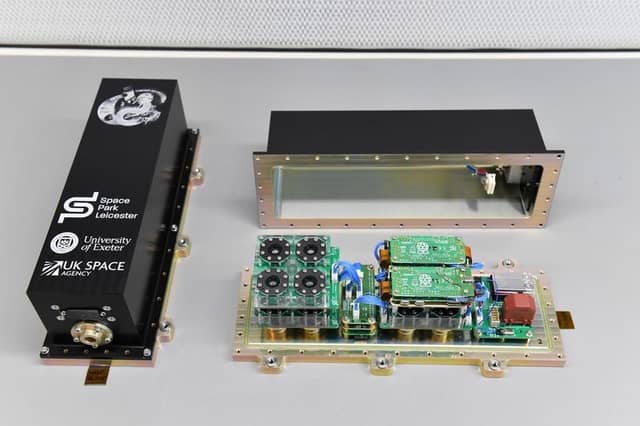

Eight-year University of Exeter study into how space travel affects worms to launch to the International Space Station.
Around 30 worms will be sent to the International Space Station next year as part of a University of Exeter experiment examining how long-duration space travel affects living organisms.
The mission, scheduled for launch in April 2026, follows more than eight years of scientific development in Exeter.
The total cost of the project is around £500,000, including commercial launch fees, with a further £250,000 invested in earlier development. Funding is provided by the UK Space Agency, with launch support from Voyager Technologies in the United States.
The experiment will use C. elegans, a type of nematode worm frequently used in medical, genetic and space research. Their built-in fluorescent markers allow scientists to track stress responses and health in real time via onboard imaging.
The project has since expanded into a collaboration between the University of Exeter and engineers at the University of Leicester, who were brought in to design and build the specialist hardware needed to carry the worms into space.
Working from the Exeter team’s biological specifications, engineers at Space Park Leicester designed and built the small space laboratory known as the “Petri Pod”.
The Petri Pod is a compact, automated experimental unit measuring around 10×10×30cm and weighing three kilograms.
Inside are 12 sealed pods capable of supporting small organisms with food, water and air, even when exposed to the vacuum of space. The unit also contains a miniaturised fluorescent microscope, a first for UK-built space biology hardware.
Following its initial operation inside the ISS, the Petri Pod will be moved to an external platform for at least 15 weeks, exposing the worms (and several microbial and material samples) to microgravity, deep-space radiation, and near-vacuum conditions.
Data on the worms' wellbeing, along with environmental measurements such as temperature and radiation levels, will be stored for retrieval when the device is returned to Earth on a later cargo flight.
Professor Tim Etheridge, scientific lead for the project at the University of Exeter, said the mission represents a major step forward for UK space-based biology research.
“This hardware does several key things,” he said.
“It provides a unique platform for biological experiments by automating operations remotely, miniaturises fluorescent microscopy for space use, and is adaptable to multiple types of biological samples. It essentially contains a miniature life support system.”
He added that the ISS is being used as a proving ground for technology ultimately intended for satellites and deep-space missions.
“We’re essentially co-opting the ISS as a big satellite for this first demonstration, making use of its power and communications systems.”
Exeter scientists co-designed the concept behind the device, carried out the biological testing required to validate it, developed early prototypes alongside Leicester engineers, and have led the preparations for launch.
Researchers say the work will contribute to understanding biological risks associated with long-term spaceflight (such as muscle and bone loss, vision changes and radiation-related cell damage) knowledge that will be important for future missions to the Moon and Mars.
Professor Mark Sims at the University of Leicester said the mission demonstrates growing UK capability in space-based life sciences and supports the wider development of future deep-space research platforms.
The worms will be installed into the hardware shortly before launch in 2026, ahead of their journey from Earth to the ISS.