

24-day closure highlights 'rising tide' of Devon rail disruption

'Creaking' infrastructure: The long-term challenge of flood-proofing Devon’s railways
Rail passengers in the South West are facing nearly five times as much disruption from flooding as they did a decade ago, new figures suggest.
Analysis of Network Rail data shows that flood-related delays across the region have surged by 386 per cent compared with the mid-2010s.
The figures come as users of the Tarka Line, which connects Barnstaple and Exeter, continue to count the cost of increasingly volatile weather.
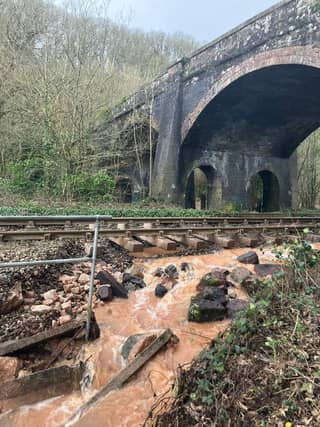
Earlier this year, the vital commuter link was forced to close for 24 consecutive days following extreme rainfall from Storm Chandra. The closure left thousands of North Devon residents reliant on replacement bus services as engineers worked to repair trackbeds washed away by the River Creedy.
The figures were uncovered by Round Our Way, a non-profit group that highlights how weather changes are affecting local communities.
The data shows a “rising tide” of cancellations across the region. Round Our Way warned that the South West's rail network is “buckling” under the pressure of floods, landslips, and extreme rainfall.
On average, travelers in the region now face 2,862 minutes of flood delays every year. In the mid-2010s, that yearly average was nearly five times lower, at just 589 minutes.
“The rail network appears to be under persistent weather stress,” said Sofie Jenkinson, co-director of Round Our Way.
The group has suggested that the UK is not ready for climate change.
“We are not prepared for the impact that climate change is already having on ordinary Brits’ way of life.”
In a flood disruption hot spot map, generated by the research organisation, stations at Barnstaple, Eggesford, Crediton, Okehampton and Exeter St David’s were all flagged up.
For many in the South West, the statistics simply confirm what they see on the platform display boards.
The 24-day closure of the Tarka Line in early 2026 was one of the longest continuous weather-related disruptions in the line's history. Network Rail reported that floodwater removed the stone ballast supporting the tracks at nine different sites between Exeter and Crediton.
The Met Office notes that the last decade has been 10 per cent wetter than the period between 1961 and 1990.
How was the data calculated?
To maintain transparency, the report's authors outlined how the figures were reached:
- Source: The data was provided by Network Rail following a Freedom of Information request covering April 2014 to December 2025.
- Incident Types: Researchers focused specifically on incidents coded as “110A X2”, defined by the rail industry as severe flooding beyond the design capability of the infrastructure.
- Metrics: The study used “Passenger Delay Minutes” (PfPI), a standard industry measure that calculates the total time lost by all passengers on a disrupted service.
- Comparison: The 386 per cent increase was found by comparing the annual average of delays from 2014-2017 against the most recent three-year period (2022–2025).
According to the analysis, several locations in the South West have recorded 25 or more flood incidents since 2014, including:
- Tiverton Parkway
- Liskeard
- Bristol Temple Meads
- Swindon and Chippenham
Ms Jenkinson said the “significant rise” in delays raised concerns about the safety of the UK's “creaking rail infrastructure.”
She added: “We are all sadly getting very familiar with the impact climate change-driven extreme weather is having on the country. This is worrying but it is also fixable.
“Politicians need to show leadership to better prepare us for weather extremes and challenge the companies profiting from pollution which creates these impacts in the first place.”